Spring基础教程(六)
Bean定义(Annotation方式一)
项目目录结构如下:
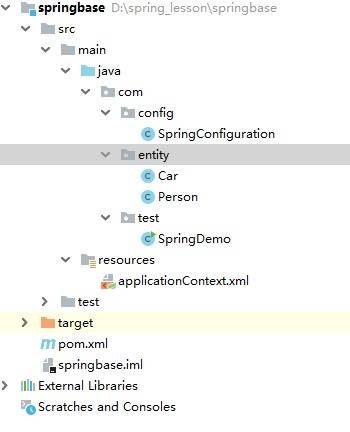
把上节的基于XML的Bean定义,改写为注解方式,实现步骤如下:
1.编写Person与Car实体类
在Person类的car属性上添加注解实现自动注入。实现方式有以下两种: 1)@Autowired+@Qualifier 2)@Resource(name="xxx") 或者属性名字和bean的name保持一致。
注意:@Autowired是spring提供的注释,@Resource是JAVA2EE提供的。使用@Resource注解需要添加annotation 依赖。在pom.xml中添加以下依赖:
<!-- https://mvnrepository.com/artifact/javax.annotation/javax.annotation-api -->
<dependency>
     <groupId>javax.annotation</groupId>
     <artifactId>javax.annotation-api</artifactId>
     <version>1.3.2</version>
</dependency>
package com.entity;

import org.springframework.beans.factory.annotation.Autowired;
import org.springframework.beans.factory.annotation.Qualifier;

import javax.annotation.Resource;

public class Person {

    private String name;
    private String gender;
    private int age;

    /*
    方式一:@Autowired+@Qualifier
    @Autowired
    @Qualifier("car2")
    */
    //方式二:@Resource(name="xxx") 或者属性名字和bean的name保持一致。
    //如果使用@Resource,要求属性名字改为car2;
    @Resource(name="car2")

    private Car car;


    public Person() {
    }

    public Person(String name, String gender, int age) {
        this.name = name;
        this.gender = gender;
        this.age = age;
    }

    public String getName() {
        return name;
    }

    public void setName(String name) {
        this.name = name;
    }

    public String getGender() {
        return gender;
    }

    public void setGender(String gender) {
        this.gender = gender;
    }

    public int getAge() {
        return age;
    }

    public void setAge(int age) {
        this.age = age;
    }

    public Car getCar() {
        return car;
    }

    public void setCar(Car car) {
        this.car = car;
    }

    @Override
    public String toString() {
        return "Person{" +
                "name='" + name + '\'' +
                ", gender='" + gender + '\'' +
                ", age=" + age +
                ", car=" + car +
                '}';
    }
}


package com.entity;

public class Car {

    private String brand;
    private String color;

    public Car() {
    }

    public Car(String brand, String color) {
        this.brand = brand;
        this.color = color;
    }

    public String getBrand() {
        return brand;
    }

    public void setBrand(String brand) {
        this.brand = brand;
    }

    public String getColor() {
        return color;
    }

    public void setColor(String color) {
        this.color = color;
    }

    @Override
    public String toString() {
        return "Car{" +
                "brand='" + brand + '\'' +
                ", color='" + color + '\'' +
                '}';
    }
}
2.在SpringConfiguration类中定义bean. 这里我们定义一个Person类型的bean和两个Car类型的bean.通过注解的方式实现person bean对象的car属性注入的是car2对象。
package com.config;

import com.entity.Car;
import com.entity.Person;
import org.springframework.context.annotation.Bean;
import org.springframework.context.annotation.ComponentScan;
import org.springframework.context.annotation.Configuration;

@Configuration
@ComponentScan(basePackages = "com")
public class SpringConfiguration {

    @Bean(name = {"p1","person"})
    public Person getPerson(){
        return new Person("zhangsan","男",20);
    }

    @Bean("car1")
    public Car getCar1(){
        return new Car("BMW","black");
    }

    @Bean("car2")
    public Car getCar2(){
        return new Car("BENZ","red");
    }

}
3.编写测试类
package com.test;

import com.config.SpringConfiguration;
import com.entity.Person;
import org.springframework.context.ApplicationContext;
import org.springframework.context.annotation.AnnotationConfigApplicationContext;
import org.springframework.context.support.ClassPathXmlApplicationContext;

public class SpringDemo {

    public static void main(String[] args) {

        AnnotationConfigApplicationContext context = new AnnotationConfigApplicationContext(SpringConfiguration.class);
        Person person = (Person) context.getBean("p1");
        System.out.println(person);
    }

}
4.测试运行

@Autowired与 @Resource区别
- @Autowired与@Resource都可以用来装配bean. 都可以写在字段上,或写在setter方法上。
- @Autowired默认按byType注入,byName需要与@Qualifier("对象名")连用@Resource同时支持byType和byName注入,默认按byName注入,如果默认情况下找不到就按类型找(name属性解析为bean的名字,而type属性则解析为bean的类型)
- @Resource默认按照名称进行装配,名称可以通过name属性进行指定,如果没有指定name属性,当注解写在字段上时,默认取字段名进行安装名称查找,如果注解写在setter方法上默认取属性名进行装配。
- @Autowired是spring提供的注释,@Resource是JAVA2EE提供的,需要导入包javax.annotation.Resource。
- 推荐使用:@Resource注解在字段上,这样就不用写setter方法了,并且这个注解是属于J2EE的,减少了与spring的耦合。这样代码看起就比较优雅。