WebUI之Streamlit
WebUI之Streamlit
Streamlit是一个用于机器学习、数据可视化的 Python 框架,它能几行代码就构建出一个精美的在线 app 应用。相比于Gradio它有更强大的功能。

1.Streamlit的安装
# 安装
pip install streamlit
pip install streamlit-chat


# 测试
streamlit hello
  Local URL: http://localhost:8501
  Network URL: http://192.168.3.41:8501

  Ready to create your own Python apps super quickly?
  Head over to https://docs.streamlit.io

  May you create awesome apps!
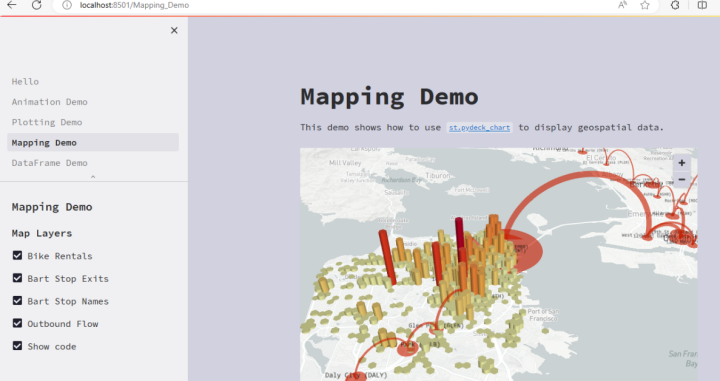
会出现一些案例:
2.Streamlit基本语法
import streamlit as st
最常用的几种
- 标题st.title() : st.title("标题")
- 写入st.write(): st.write("Hello world ")
- 文本st.text():单行文本
- 多行文本框st.text_area():st.text_area("文本框",value=''key=None)
- 滑动条st.slider():st.slider(““)
- 按钮st.button():st.button(“按钮“)
- 输入文本st.text_input():st.text_input(“请求用户输入“)
- 单选框组件st.radio()
- st.image() : 图片
- st.audio() : 语音
- st.video() : 视频
- st.progress() : 显示进度
- st.spinner() : 显示执行状态
- st.error() : 显示错误信息
- st.warning : 显示警告信息
3.创建一个简单的app
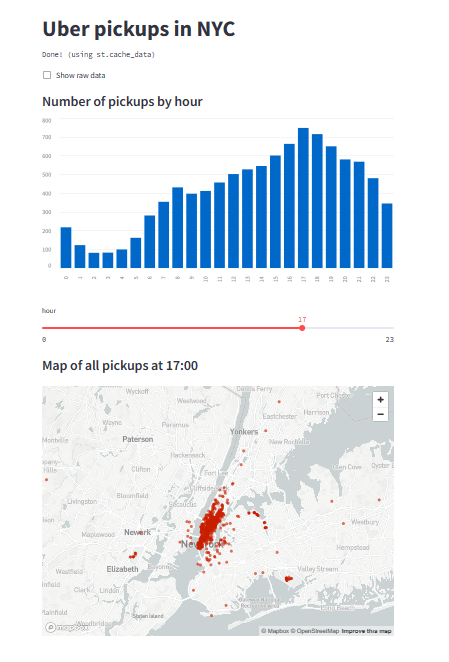
实时读取数据并作图。
app.py
import streamlit as st
import pandas as pd
import numpy as np

st.title('Uber pickups in NYC')

DATE_COLUMN = 'Date/Time'

DATA_URL = ('./data/uber-raw-data-sep14.csv')

# 增加缓存
@st.cache_data
# 下载数据函数
def load_data(nrows):
    # 读取csv文件
    data = pd.read_csv(DATA_URL, nrows=nrows)

    # 将数据以panda的数据列的形式展示出来
    data[DATE_COLUMN] = pd.to_datetime(data[DATE_COLUMN])
    # 返回最终数据
    return data


# 直接打印文本信息
data_load_state = st.text('正在下载')
# 下载一万条数据中的数据
data = load_data(10000)
# 最后输出文本显示
data_load_state.text("完成!(using st.cache_data)")

# 检查原始数据
if st.checkbox('Show raw data'):
    st.subheader('Raw data')
    st.write(data)

# 绘制直方图
# 添加一个子标题
st.subheader('Number of pickups by hour')

# 使用numpy生成一个直方图,按小时排列
hist_values = np.histogram(data[DATE_COLUMN].dt.hour, bins=24, range=(0, 24))[0]
# 使用Streamlit 的 st.bar_chart() 方法来绘制直方图
st.bar_chart(hist_values)

# 使用滑动块筛选结果
hour_to_filter = st.slider('hour', 0, 23, 17)
# 实时更新
filtered_data = data[data[DATE_COLUMN].dt.hour == hour_to_filter]

# 为地图添加一个副标题
st.subheader('Map of all pickups at %s:00' % hour_to_filter)
# 使用st.map()函数绘制数据
st.map(filtered_data)
运行
streamlit run app.py
其中uber-raw-data-sep14.csv数据集下载地址如下:
链接:https://pan.baidu.com/s/1vv_TP5o_jgwXJqsP3158QA 提取码:9527
4.Streamlit+Opencv轻松构件web应用
import cv2
import streamlit as st
import numpy as np
from PIL import Image


def brighten_image(image, amount):
    img_bright = cv2.convertScaleAbs(image, beta=amount)
    return img_bright


def blur_image(image, amount):
    blur_img = cv2.GaussianBlur(image, (11, 11), amount)
    return blur_img


def enhance_details(img):
    hdr = cv2.detailEnhance(img, sigma_s=12, sigma_r=0.15)
    return hdr


def main_loop():
    st.title("OpenCV Demo App")
    st.subheader("This app allows you to play with Image filters!")
    st.text("We use OpenCV and Streamlit for this demo")
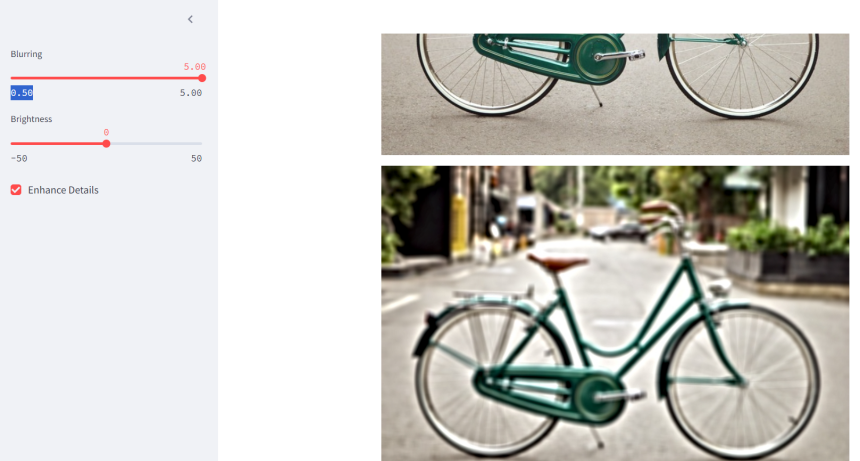
    blur_rate = st.sidebar.slider("Blurring", min_value=0.5, max_value=5.0)
    brightness_amount = st.sidebar.slider("Brightness", min_value=-50, max_value=50, value=0)
    apply_enhancement_filter = st.sidebar.checkbox('Enhance Details')
    image_file = st.file_uploader("Upload Your Image", type=['jpg', 'png', 'jpeg'])

    if not image_file:
        return None

    original_image = Image.open(image_file)
    original_image = np.array(original_image)
    processed_image = blur_image(original_image, blur_rate)
    processed_image = brighten_image(processed_image, brightness_amount)
    if apply_enhancement_filter:
        processed_image = enhance_details(processed_image)

    st.text("Original Image vs Processed Image")
    st.image([original_image, processed_image])


if __name__ == '__main__':
    main_loop()
运行效果:
5.基于StreamlitUI构建聊天机器人
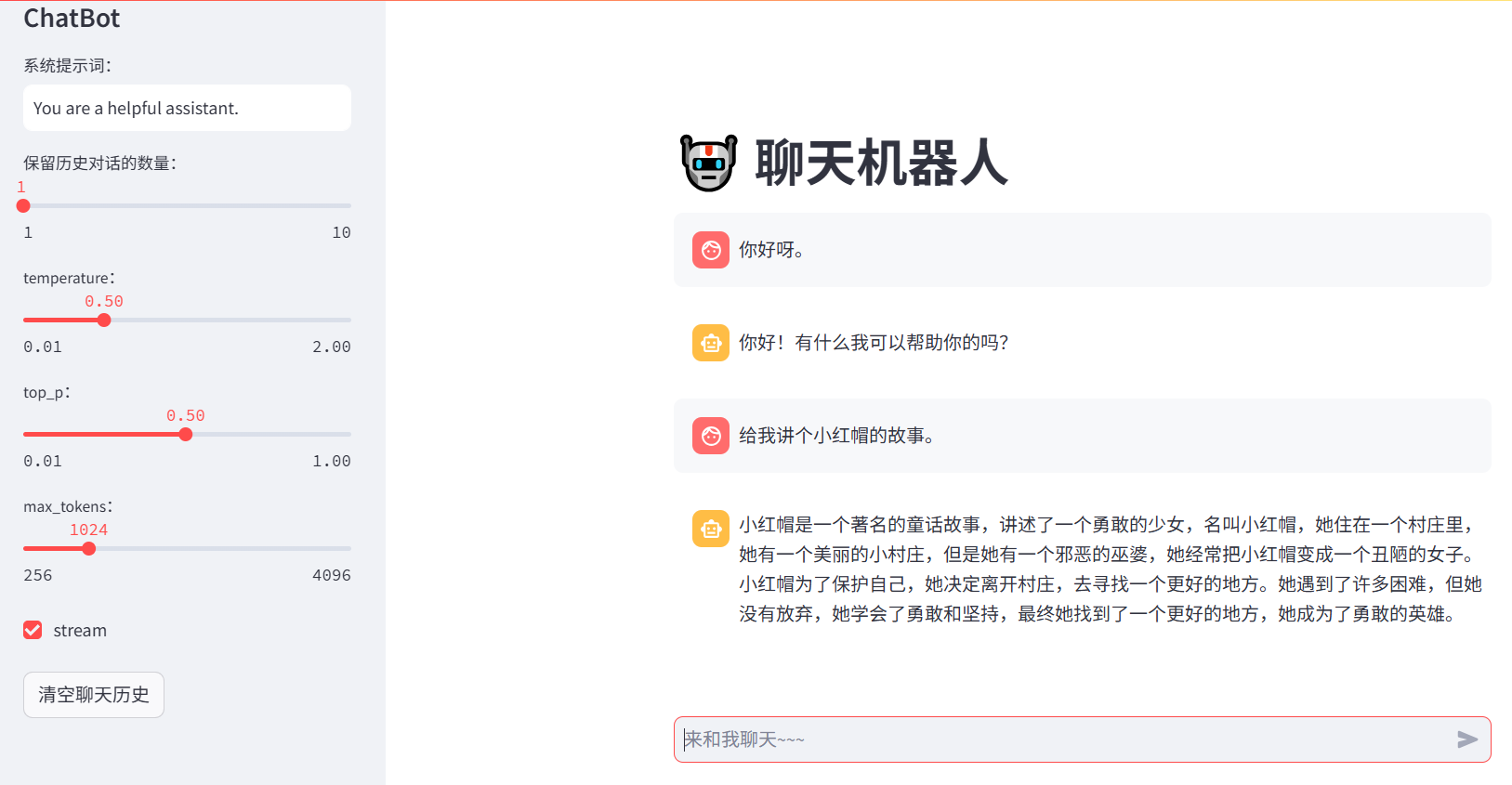
在上一节的基于FastAPI构建聊天机器人的基础上使用Streamlit-UI构建聊天界面。
为了保证兼容性,推荐安装以下版本的streamlit。
pip install streamlit==1.39.0
代码实现:
streamlitui_robot_chat.py
import streamlit as st
import requests

# 定义fastapi后端服务器地址
backend_url = "http://127.0.0.1:6066/chat"

# 设计页面
st.set_page_config(page_title="ChatBot", layout="centered")
# 设计聊天对话框
st.title("基于Streamlit的聊天机器人")

def clear_chat_history():
    st.session_state.history = []

# st.sidebar负责设计侧边栏
with st.sidebar:
    st.title("ChatBot")
    sys_prompt = st.text_input("系统提示词:", value="You are a helpful assistant.")
    history_len = st.slider("保留历史对话的数量:", min_value=1, max_value=10, value=1, step=1)
    temperature = st.slider("temperature:", min_value=0.01, max_value=2.0, value=0.5, step=0.01)
    top_p = st.slider("top_p:", min_value=0.01, max_value=1.0, value=0.5, step=0.01)
    max_tokens = st.slider("max_tokens:", min_value=256, max_value=4096, value=1024, step=8)
    stream = st.checkbox("stream", value=True)
    st.button("清空聊天历史", on_click=clear_chat_history)

# 定义存储历史
if "history" not in st.session_state:
    st.session_state.history = []

# 显示聊天历史
for messgae in st.session_state.history:
    with st.chat_message(messgae["role"]):
        st.markdown(messgae["content"])

# 输入框
# 海象运算符(:=), 用于检查赋值的内容(prompt)是否为空
if prompt := st.chat_input("来和我聊天~~~"):
    # 显示用户消息
    with st.chat_message("user"):
        st.markdown(prompt)
    # 构建请求数据
    data = {
        "query": prompt,
        "sys_prompt": sys_prompt,
        "history_len": history_len,
        "history": st.session_state.history,
        "temperature": temperature,
        "top_p": top_p,
        "max_tokens": max_tokens
    }

    # 发送请求到fastapi后端
    response = requests.post(backend_url, json=data, stream=True)
    if response.status_code == 200:
        chunks = ""
        assistant_placeholder = st.chat_message("assistant")
        assistant_text = assistant_placeholder.markdown("")
        if stream:  # 流式输出
            for chunk in response.iter_content(chunk_size=None, decode_unicode=True):
                # 处理响应的内容,并累加起来
                chunks += chunk
                # 实时显示和更新助手的消息
                assistant_text.markdown(chunks)
        else:
            for chunk in response.iter_content(chunk_size=None, decode_unicode=True):
                chunks += chunk
            assistant_text.markdown(chunks)
        st.session_state.history.append({"role": "user", "content": prompt})
        st.session_state.history.append({"role": "assistant", "content": chunks})
分别启动vLLM推理服务器和FastAPI后端聊天接口。然后输入以下命令,启动聊天界面:
streamlit run streamlitui_robot_chat.py
运行效果: