GoogleNet网络
GoogleNet网络
GoogLeNet是2014年Christian Szegedy提出的一种全新的深度学习结构,在这之前的AlexNet、VGG等结构都是通过增大网络的深度(层数)来获得更好的训练效果,但层数的增加会带来很多负作用,比如overfit、梯度消失、梯度爆炸等。inception的提出则从另一种角度来提升训练结果:能更高效的利用计算资源,在相同的计算量下能提取到更多的特征,从而提升训练结果。
1.GooleNet简介
GoogleNet,也被称为Inception-v1,是由Google的研究人员在2014年提出的一种深度卷积神经网络(CNN),并在当年的ImageNet大规模视觉识别挑战赛(ILSVRC 2014)中获得了第一名。GoogleNet的主要设计目标是在不显著增加计算成本的前提下,提高网络的深度和宽度,从而提高模型的准确率。
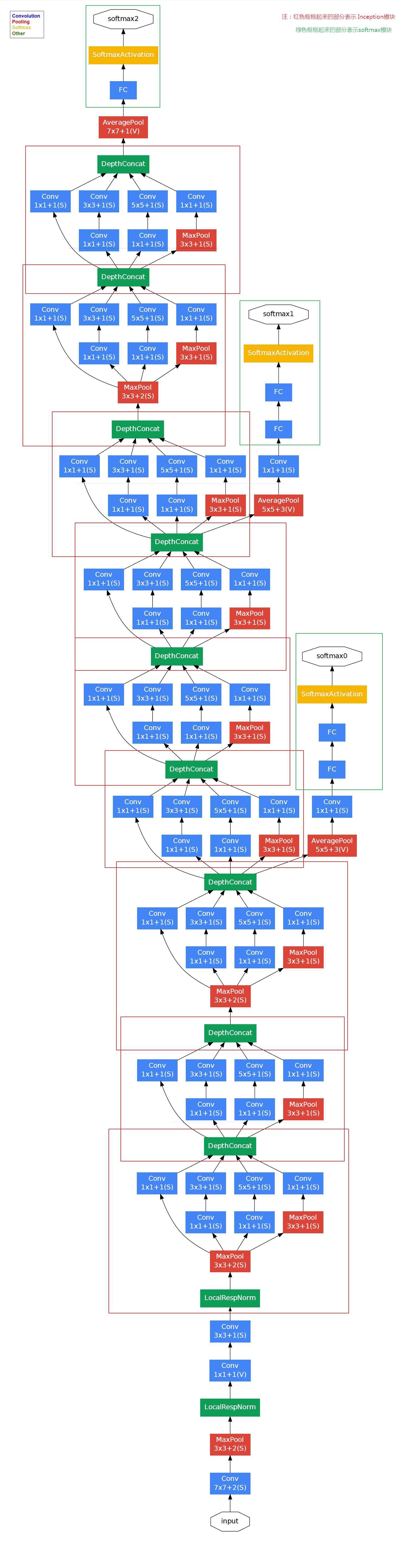
GoogleNet的核心思想是通过引入Inception模块来提高模型的效率和表现。Inception模块允许网络在同一层中并行处理多种尺度的信息,通过不同大小的卷积核和池化层捕捉不同的特征。Inception模块包含多个分支,每个分支使用不同大小的卷积核(如1x1、3x3、5x5)和池化操作,最终将各分支的输出在通道维度上拼接起来,形成最终的输出特征图。
2.关键技术和创新点
- 1x1卷积:在Inception模块中,1x1卷积主要用于降维,减少计算负担,并增加非线性。通过减少特征图的深度,1x1卷积能有效控制参数数量,同时增强网络的表达能力。
- 辅助分类器:GoogleNet设计了两个辅助分类器,它们在训练过程中帮助模型学习中间层的特征,并通过反向传播优化整个网络。
- 全局平均池化:在网络的最后,使用全局平均池化层代替传统的全连接层进行分类,进一步减少参数量和计算复杂度。
3.GooleNet的缺点
尽管GoogLeNet在当时取得了很好的成绩,但它也有一些缺点:
- 由于其使用了Inception模块,网络的计算复杂度较高。这使得GoogLeNet的训练速度较慢,不太适合对实时性要求较高的应用。
- GoogLeNet的网络结构相对复杂,不太容易理解,并且由于辅助分类器的存在,这使得在调试和优化网络时较为困难。
总之,GoogLeNet的计算复杂度高、网络结构复杂是其主要缺点。
4.GoogleNet实现花卉分类
model.py
import torch.nn as nn
import torch
import torch.nn.functional as F


class GoogLeNet(nn.Module):
    def __init__(self, num_classes=1000, aux_logits=True, init_weights=False):
        super(GoogLeNet, self).__init__()
        self.aux_logits = aux_logits

        self.conv1 = BasicConv2d(3, 64, kernel_size=7, stride=2, padding=3)
        self.maxpool1 = nn.MaxPool2d(3, stride=2, ceil_mode=True)  # ceil_mode=true 得到的小数向上取整 ceil_mode=false 向下取整

        self.conv2 = BasicConv2d(64, 64, kernel_size=1)  # 第一个64是输入特征矩阵深度,第二个64是卷积核的个数
        self.conv3 = BasicConv2d(64, 192, kernel_size=3, padding=1)
        self.maxpool2 = nn.MaxPool2d(3, stride=2, ceil_mode=True)

        self.inception3a = Inception(192, 64, 96, 128, 16, 32, 32)  # 第一个参数是输入特征矩阵深度,后面的参数都是按照表格中的参数
        self.inception3b = Inception(256, 128, 128, 192, 32, 96, 64)
        self.maxpool3 = nn.MaxPool2d(3, stride=2, ceil_mode=True)

        self.inception4a = Inception(480, 192, 96, 208, 16, 48, 64)
        self.inception4b = Inception(512, 160, 112, 224, 24, 64, 64)
        self.inception4c = Inception(512, 128, 128, 256, 24, 64, 64)
        self.inception4d = Inception(512, 112, 144, 288, 32, 64, 64)
        self.inception4e = Inception(528, 256, 160, 320, 32, 128, 128)
        self.maxpool4 = nn.MaxPool2d(3, stride=2, ceil_mode=True)

        self.inception5a = Inception(832, 256, 160, 320, 32, 128, 128)
        self.inception5b = Inception(832, 384, 192, 384, 48, 128, 128)

        if self.aux_logits:
            self.aux1 = InceptionAux(512, num_classes)  # 4a的输出
            self.aux2 = InceptionAux(528, num_classes)  # 4d的输出

        self.avgpool = nn.AdaptiveAvgPool2d(
            (1, 1))  # 自适应平均池化下采样操作(1,1)是输出特征矩阵的高和宽,好处就是无论输入特征矩阵的高和宽是什么样的大小,我们都能够我们所指定的一个特征矩阵的高和宽
        self.dropout = nn.Dropout(0.4)
        self.fc = nn.Linear(1024, num_classes)
        if init_weights:
            self._initialize_weights()

    def forward(self, x):  # 网络的正向传播过程
        # N x 3 x 224 x 224
        x = self.conv1(x)
        # N x 64 x 112 x 112
        x = self.maxpool1(x)
        # N x 64 x 56 x 56
        x = self.conv2(x)
        # N x 64 x 56 x 56
        x = self.conv3(x)
        # N x 192 x 56 x 56
        x = self.maxpool2(x)

        # N x 192 x 28 x 28
        x = self.inception3a(x)
        # N x 256 x 28 x 28
        x = self.inception3b(x)
        # N x 480 x 28 x 28
        x = self.maxpool3(x)
        # N x 480 x 14 x 14
        x = self.inception4a(x)
        # N x 512 x 14 x 14
        if self.training and self.aux_logits:  # eval model lose this layer
            aux1 = self.aux1(x)

        x = self.inception4b(x)
        # N x 512 x 14 x 14
        x = self.inception4c(x)
        # N x 512 x 14 x 14
        x = self.inception4d(x)
        # N x 528 x 14 x 14
        if self.training and self.aux_logits:  # eval model lose this layer
            aux2 = self.aux2(x)

        x = self.inception4e(x)
        # N x 832 x 14 x 14
        x = self.maxpool4(x)
        # N x 832 x 7 x 7
        x = self.inception5a(x)
        # N x 832 x 7 x 7
        x = self.inception5b(x)
        # N x 1024 x 7 x 7

        x = self.avgpool(x)
        # N x 1024 x 1 x 1
        x = torch.flatten(x, 1)
        # N x 1024
        x = self.dropout(x)
        x = self.fc(x)
        # N x 1000 (num_classes)
        if self.training and self.aux_logits:  # eval model lose this layer
            return x, aux2, aux1
        return x

    def _initialize_weights(self):
        for m in self.modules():
            if isinstance(m, nn.Conv2d):
                nn.init.kaiming_normal_(m.weight, mode='fan_out', nonlinearity='relu')
                if m.bias is not None:
                    nn.init.constant_(m.bias, 0)
            elif isinstance(m, nn.Linear):
                nn.init.normal_(m.weight, 0, 0.01)
                nn.init.constant_(m.bias, 0)


class Inception(nn.Module):  # Inception模板
    def __init__(self, in_channels, ch1x1, ch3x3red, ch3x3, ch5x5red, ch5x5, pool_proj):
        super(Inception, self).__init__()

        self.branch1 = BasicConv2d(in_channels, ch1x1, kernel_size=1)

        self.branch2 = nn.Sequential(  # 传入非关键字的参数
            BasicConv2d(in_channels, ch3x3red, kernel_size=1),
            BasicConv2d(ch3x3red, ch3x3, kernel_size=3, padding=1)  # 保证输出特征矩阵大小等于输入大小
        )

        self.branch3 = nn.Sequential(
            BasicConv2d(in_channels, ch5x5red, kernel_size=1),
            # 在官方的实现中,其实是3x3的kernel并不是5x5,这里我也懒得改了,具体可以参考下面的issue
            # Please see https://github.com/pytorch/vision/issues/906 for details.
            BasicConv2d(ch5x5red, ch5x5, kernel_size=5, padding=2)  # 保证输出大小等于输入大小
        )

        self.branch4 = nn.Sequential(
            nn.MaxPool2d(kernel_size=3, stride=1, padding=1),
            BasicConv2d(in_channels, pool_proj, kernel_size=1)
        )

    def forward(self, x):  # 正向传播过程
        branch1 = self.branch1(x)
        branch2 = self.branch2(x)
        branch3 = self.branch3(x)
        branch4 = self.branch4(x)

        outputs = [branch1, branch2, branch3, branch4]  # 将4个分支的输出放入到一个列表当中
        return torch.cat(outputs, 1)  # 通过cat函数将这4个分支进行合并,在第一个维度也就是channel深度进行合并


class InceptionAux(nn.Module):  # 定义辅助分类器模板
    def __init__(self, in_channels, num_classes):
        super(InceptionAux, self).__init__()
        self.averagePool = nn.AvgPool2d(kernel_size=5, stride=3)
        self.conv = BasicConv2d(in_channels, 128, kernel_size=1)  # output[batch, 128, 4, 4]

        self.fc1 = nn.Linear(2048, 1024)  # 2048是展平后的节点个数128*4*4
        self.fc2 = nn.Linear(1024, num_classes)

    def forward(self, x):
        # aux1: N x 512 x 14 x 14, aux2: N x 528 x 14 x 14 输入特征矩阵的维度
        x = self.averagePool(x)
        # aux1: N x 512 x 4 x 4, aux2: N x 528 x 4 x 4
        x = self.conv(x)
        # N x 128 x 4 x 4
        x = torch.flatten(x, 1)
        x = F.dropout(x, 0.5, training=self.training)  # 当我们实例化一个模型model后,可以通过model.train()和model.eval()来控制模型的状态,
        # 在model.train()模式下self.training=True,在model.eval()模式下self.training=False
        # N x 2048
        x = F.relu(self.fc1(x), inplace=True)
        x = F.dropout(x, 0.5, training=self.training)
        # N x 1024
        x = self.fc2(x)
        # N x num_classes
        return x


class BasicConv2d(nn.Module):  # 卷积模板文件
    def __init__(self, in_channels, out_channels, **kwargs):
        super(BasicConv2d, self).__init__()
        self.conv = nn.Conv2d(in_channels, out_channels, **kwargs)
        self.relu = nn.ReLU(inplace=True)

    def forward(self, x):  # 正向传播过程
        x = self.conv(x)
        x = self.relu(x)
        return x
train.py
import os
import sys
import json

import torch
import torch.nn as nn
from torchvision import transforms, datasets
import torch.optim as optim
from tqdm import tqdm

from model import GoogLeNet


def main():
    device = torch.device("cuda:0" if torch.cuda.is_available() else "cpu")
    print("using {} device.".format(device))

    data_transform = {
        "train": transforms.Compose([transforms.RandomResizedCrop(224),
                                     transforms.RandomHorizontalFlip(),
                                     transforms.ToTensor(),
                                     transforms.Normalize((0.5, 0.5, 0.5), (0.5, 0.5, 0.5))]),
        "val": transforms.Compose([transforms.Resize((224, 224)),
                                   transforms.ToTensor(),
                                   transforms.Normalize((0.5, 0.5, 0.5), (0.5, 0.5, 0.5))])}

    data_root = os.path.abspath(os.path.join(os.getcwd()))  # get data root path
    image_path = os.path.join(data_root, "data_set", "flower_data")  # flower data set path
    assert os.path.exists(image_path), "{} path does not exist.".format(image_path)
    train_dataset = datasets.ImageFolder(root=os.path.join(image_path, "train"),
                                         transform=data_transform["train"])
    train_num = len(train_dataset)

    # {'daisy':0, 'dandelion':1, 'roses':2, 'sunflower':3, 'tulips':4}
    flower_list = train_dataset.class_to_idx
    cla_dict = dict((val, key) for key, val in flower_list.items())
    # write dict into json file
    json_str = json.dumps(cla_dict, indent=4)
    with open('class_indices.json', 'w') as json_file:
        json_file.write(json_str)

    batch_size = 32
    nw = min([os.cpu_count(), batch_size if batch_size > 1 else 0, 8])  # number of workers
    print('Using {} dataloader workers every process'.format(nw))

    train_loader = torch.utils.data.DataLoader(train_dataset,
                                               batch_size=batch_size, shuffle=True,
                                               num_workers=0)

    validate_dataset = datasets.ImageFolder(root=os.path.join(image_path, "val"),
                                            transform=data_transform["val"])
    val_num = len(validate_dataset)
    validate_loader = torch.utils.data.DataLoader(validate_dataset,
                                                  batch_size=batch_size, shuffle=False,
                                                  num_workers=0)

    print("using {} images for training, {} images for validation.".format(train_num,
                                                                           val_num))

    # test_data_iter = iter(validate_loader)
    # test_image, test_label = test_data_iter.next()

    net = GoogLeNet(num_classes=5, aux_logits=True, init_weights=True)
    # 如果要使用官方的预训练权重,注意是将权重载入官方的模型,不是我们自己实现的模型
    # 官方的模型中使用了bn层以及改了一些参数,不能混用
    # import torchvision
    # net = torchvision.models.googlenet(num_classes=5)
    # model_dict = net.state_dict()
    # # 预训练权重下载地址: https://download.pytorch.org/models/googlenet-1378be20.pth
    # pretrain_model = torch.load("googlenet.pth")
    # del_list = ["aux1.fc2.weight", "aux1.fc2.bias",
    #             "aux2.fc2.weight", "aux2.fc2.bias",
    #             "fc.weight", "fc.bias"]
    # pretrain_dict = {k: v for k, v in pretrain_model.items() if k not in del_list}
    # model_dict.update(pretrain_dict)
    # net.load_state_dict(model_dict)
    net.to(device)
    loss_function = nn.CrossEntropyLoss()
    optimizer = optim.Adam(net.parameters(), lr=0.0003)

    epochs = 10
    best_acc = 0.0
    save_path = './googleNet.pth'
    train_steps = len(train_loader)
    for epoch in range(epochs):
        # train
        net.train()
        running_loss = 0.0
        train_bar = tqdm(train_loader, file=sys.stdout)
        for step, data in enumerate(train_bar):
            images, labels = data
            optimizer.zero_grad()
            logits, aux_logits2, aux_logits1 = net(images.to(device))
            loss0 = loss_function(logits, labels.to(device))
            loss1 = loss_function(aux_logits1, labels.to(device))
            loss2 = loss_function(aux_logits2, labels.to(device))
            loss = loss0 + loss1 * 0.3 + loss2 * 0.3
            loss.backward()  # 将损失反向传播
            optimizer.step()  # 更新模型参数

            # print statistics
            running_loss += loss.item()

            train_bar.desc = "train epoch[{}/{}] loss:{:.3f}".format(epoch + 1,
                                                                     epochs,
                                                                     loss)

        # validate 验证
        net.eval()
        acc = 0.0  # accumulate accurate number / epoch
        with torch.no_grad():
            val_bar = tqdm(validate_loader, file=sys.stdout)  # 添加一个进度条
            for val_data in val_bar:
                val_images, val_labels = val_data
                outputs = net(val_images.to(device))  # eval model only have last output layer测试过程中不需要管辅助分类器的结果
                predict_y = torch.max(outputs, dim=1)[1]
                acc += torch.eq(predict_y, val_labels.to(device)).sum().item()

        val_accurate = acc / val_num
        print('[epoch %d] train_loss: %.3f  val_accuracy: %.3f' %
              (epoch + 1, running_loss / train_steps, val_accurate))

        if val_accurate > best_acc:
            best_acc = val_accurate
            torch.save(net.state_dict(), save_path)

    print('Finished Training')


if __name__ == '__main__':
    main()
predict.py
import os
import json

import torch
from PIL import Image
from torchvision import transforms
import matplotlib.pyplot as plt

from model import GoogLeNet


def main():
    device = torch.device("cuda:0" if torch.cuda.is_available() else "cpu")

    data_transform = transforms.Compose(
        [transforms.Resize((224, 224)),
         transforms.ToTensor(),
         transforms.Normalize((0.5, 0.5, 0.5), (0.5, 0.5, 0.5))])

    # load image
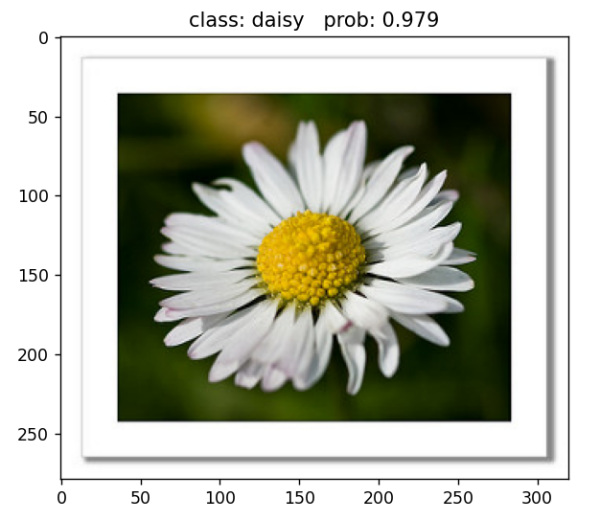
    img_path = "./images/daisy02.jpg"
    assert os.path.exists(img_path), "file: '{}' dose not exist.".format(img_path)
    img = Image.open(img_path)
    plt.imshow(img)
    # [N, C, H, W]
    img = data_transform(img)
    # expand batch dimension
    img = torch.unsqueeze(img, dim=0)

    # read class_indict
    json_path = './class_indices.json'
    assert os.path.exists(json_path), "file: '{}' dose not exist.".format(json_path)

    with open(json_path, "r") as f:
        class_indict = json.load(f)

    # create model
    model = GoogLeNet(num_classes=5, aux_logits=False).to(device)  # 预测过程中是不需要辅助分类器的

    # load model weights
    weights_path = "./googleNet.pth"
    assert os.path.exists(weights_path), "file: '{}' dose not exist.".format(weights_path)
    missing_keys, unexpected_keys = model.load_state_dict(torch.load(weights_path, map_location=device),
                                                          strict=False)  # 等于true的话精准的匹配当前模型和我们所需要载入的权重模型进行一个精准匹配

    model.eval()
    with torch.no_grad():
        # predict class
        output = torch.squeeze(model(img.to(device))).cpu()
        predict = torch.softmax(output, dim=0)
        predict_cla = torch.argmax(predict).numpy()

    print_res = "class: {}   prob: {:.3}".format(class_indict[str(predict_cla)],
                                                 predict[predict_cla].numpy())
    plt.title(print_res)
    for i in range(len(predict)):
        print("class: {:10}   prob: {:.3}".format(class_indict[str(i)],
                                                  predict[i].numpy()))
    plt.show()


if __name__ == '__main__':
    main()