Js工具链
我们开发一个完整的软件项目,除了会遇到各种各样业务层面的问题,也很遇到给类开发上的技术问题,这些技术问题大体分为以下三类。
1.开发中遇到的技术问题分类
1).语言问题
HTML: haml,比如:HTML中嵌入了浏览器不认识的代码块。 Css: sass,less,stylus,postcss,tailwind,css-in-js,styled-component Javascript: 兼容性,转换
语言问题主要就是语言兼容性和语言增强这两方面。
2).工程问题
工程问题的核心是要研究我们究竟要搭建一个什么样的工程,才能让我们的开发更高效,更易于维护和扩展。
3).流程问题
包括代码写完后如何提交,发布,自动化测试。这里会涉及很多运维的问题。
我小节的js工具链,主要就是探讨Javascript是如何处理语言兼容性和语言增强这两方面的问题。
2.Js工具链
1).语言兼容性
语言兼容性又包含以下两方面:
- API兼容
API兼容性通常是通过ployfill实现。ploy-fill最常用的库就是core-js。几乎所有的前端项目都会默认安装core-js库。
实例:
const arr = [1, 2].flatMap((x) => [x, x * 2]);
console.log(arr);

运行结果:
[ 1, 2, 2, 4 ]
目前node版本是14+,运行上面的代码是没有问题的,可以如果把node版本降低到10以后,再运行上面代码会提示不认识flatMap函数。这就是API兼容性问题。
TypeError: [1,2].flatMap is not a function
我们使用npm安装core-js,修改代码如下:
npm i core-js
require('core-js/modules/es.array.flat-map');

const arr = [1, 2].flatMap((x) => [x, x * 2]);
console.log(arr);

运行结果:
[ 1, 2, 2, 4 ]
- 语法兼容
语法兼容性的处理是语法转换(synatx transformer)就是runtime。
实例:
比如有以下代码source.js,需要对async和await进行语法转换。
//source.js
async function test() {
    return await Promise.resolve("1");
}

(async () => {
    const result = await test();
    console.log(result);
})();
我们需要安装一个名字叫:regenerator 的包。
npm i regenerator
自定义一个转换工具compiler.js
//compiler.js
const regenerator = require('regenerator');
const fs = require('fs');
const path = require('path')
const sourcePath = path.resolve(__dirname,'./source.js');
const source = fs.readFileSync(sourcePath,'utf-8');

const result =regenerator.compile(source,{includeRuntime:true});
//console.log(result);

const targetPath = path.resolve(__dirname,'./target.js');
fs.writeFileSync(targetPath,result.code,'utf-8');
console.log('compile success');
PS E:\jsdemo\synatx> node compiler.js
compile success
转换之后的target.js
/**
 * Copyright (c) 2014-present, Facebook, Inc.
 *
 * This source code is licensed under the MIT license found in the
 * LICENSE file in the root directory of this source tree.
 */

var runtime = (function (exports) {
  "use strict";

  var Op = Object.prototype;
  var hasOwn = Op.hasOwnProperty;
  var defineProperty = Object.defineProperty || function (obj, key, desc) { obj[key] = desc.value; };
  var undefined; // More compressible than void 0.
  var $Symbol = typeof Symbol === "function" ? Symbol : {};
  var iteratorSymbol = $Symbol.iterator || "@@iterator";
  var asyncIteratorSymbol = $Symbol.asyncIterator || "@@asyncIterator";
  var toStringTagSymbol = $Symbol.toStringTag || "@@toStringTag";

  function define(obj, key, value) {
    Object.defineProperty(obj, key, {
      value: value,
      enumerable: true,
      configurable: true,
      writable: true
    });
    return obj[key];
  }
  try {
    // IE 8 has a broken Object.defineProperty that only works on DOM objects.
    define({}, "");
  } catch (err) {
    define = function(obj, key, value) {
      return obj[key] = value;
    };
  }

  function wrap(innerFn, outerFn, self, tryLocsList) {
    // If outerFn provided and outerFn.prototype is a Generator, then outerFn.prototype instanceof Generator.
    var protoGenerator = outerFn && outerFn.prototype instanceof Generator ? outerFn : Generator;
    var generator = Object.create(protoGenerator.prototype);
    var context = new Context(tryLocsList || []);

    // The ._invoke method unifies the implementations of the .next,
    // .throw, and .return methods.
    defineProperty(generator, "_invoke", { value: makeInvokeMethod(innerFn, self, context) });

    return generator;
  }
  exports.wrap = wrap;

  // Try/catch helper to minimize deoptimizations. Returns a completion
  // record like context.tryEntries[i].completion. This interface could
  // have been (and was previously) designed to take a closure to be
  // invoked without arguments, but in all the cases we care about we
  // already have an existing method we want to call, so there's no need
  // to create a new function object. We can even get away with assuming
  // the method takes exactly one argument, since that happens to be true
  // in every case, so we don't have to touch the arguments object. The
  // only additional allocation required is the completion record, which
  // has a stable shape and so hopefully should be cheap to allocate.
  function tryCatch(fn, obj, arg) {
    try {
      return { type: "normal", arg: fn.call(obj, arg) };
    } catch (err) {
      return { type: "throw", arg: err };
    }
  }

  var GenStateSuspendedStart = "suspendedStart";
  var GenStateSuspendedYield = "suspendedYield";
  var GenStateExecuting = "executing";
  var GenStateCompleted = "completed";

  // Returning this object from the innerFn has the same effect as
  // breaking out of the dispatch switch statement.
  var ContinueSentinel = {};

  // Dummy constructor functions that we use as the .constructor and
  // .constructor.prototype properties for functions that return Generator
  // objects. For full spec compliance, you may wish to configure your
  // minifier not to mangle the names of these two functions.
  function Generator() {}
  function GeneratorFunction() {}
  function GeneratorFunctionPrototype() {}

  // This is a polyfill for %IteratorPrototype% for environments that
  // don't natively support it.
  var IteratorPrototype = {};
  define(IteratorPrototype, iteratorSymbol, function () {
    return this;
  });

  var getProto = Object.getPrototypeOf;
  var NativeIteratorPrototype = getProto && getProto(getProto(values([])));
  if (NativeIteratorPrototype &&
      NativeIteratorPrototype !== Op &&
      hasOwn.call(NativeIteratorPrototype, iteratorSymbol)) {
    // This environment has a native %IteratorPrototype%; use it instead
    // of the polyfill.
    IteratorPrototype = NativeIteratorPrototype;
  }

  var Gp = GeneratorFunctionPrototype.prototype =
    Generator.prototype = Object.create(IteratorPrototype);
  GeneratorFunction.prototype = GeneratorFunctionPrototype;
  defineProperty(Gp, "constructor", { value: GeneratorFunctionPrototype, configurable: true });
  defineProperty(
    GeneratorFunctionPrototype,
    "constructor",
    { value: GeneratorFunction, configurable: true }
  );
  GeneratorFunction.displayName = define(
    GeneratorFunctionPrototype,
    toStringTagSymbol,
    "GeneratorFunction"
  );

  // Helper for defining the .next, .throw, and .return methods of the
  // Iterator interface in terms of a single ._invoke method.
  function defineIteratorMethods(prototype) {
    ["next", "throw", "return"].forEach(function(method) {
      define(prototype, method, function(arg) {
        return this._invoke(method, arg);
      });
    });
  }

  exports.isGeneratorFunction = function(genFun) {
    var ctor = typeof genFun === "function" && genFun.constructor;
    return ctor
      ? ctor === GeneratorFunction ||
        // For the native GeneratorFunction constructor, the best we can
        // do is to check its .name property.
        (ctor.displayName || ctor.name) === "GeneratorFunction"
      : false;
  };

  exports.mark = function(genFun) {
    if (Object.setPrototypeOf) {
      Object.setPrototypeOf(genFun, GeneratorFunctionPrototype);
    } else {
      genFun.__proto__ = GeneratorFunctionPrototype;
      define(genFun, toStringTagSymbol, "GeneratorFunction");
    }
    genFun.prototype = Object.create(Gp);
    return genFun;
  };

  // Within the body of any async function, `await x` is transformed to
  // `yield regeneratorRuntime.awrap(x)`, so that the runtime can test
  // `hasOwn.call(value, "__await")` to determine if the yielded value is
  // meant to be awaited.
  exports.awrap = function(arg) {
    return { __await: arg };
  };

  function AsyncIterator(generator, PromiseImpl) {
    function invoke(method, arg, resolve, reject) {
      var record = tryCatch(generator[method], generator, arg);
      if (record.type === "throw") {
        reject(record.arg);
      } else {
        var result = record.arg;
        var value = result.value;
        if (value &&
            typeof value === "object" &&
            hasOwn.call(value, "__await")) {
          return PromiseImpl.resolve(value.__await).then(function(value) {
            invoke("next", value, resolve, reject);
          }, function(err) {
            invoke("throw", err, resolve, reject);
          });
        }

        return PromiseImpl.resolve(value).then(function(unwrapped) {
          // When a yielded Promise is resolved, its final value becomes
          // the .value of the Promise<{value,done}> result for the
          // current iteration.
          result.value = unwrapped;
          resolve(result);
        }, function(error) {
          // If a rejected Promise was yielded, throw the rejection back
          // into the async generator function so it can be handled there.
          return invoke("throw", error, resolve, reject);
        });
      }
    }

    var previousPromise;

    function enqueue(method, arg) {
      function callInvokeWithMethodAndArg() {
        return new PromiseImpl(function(resolve, reject) {
          invoke(method, arg, resolve, reject);
        });
      }

      return previousPromise =
        // If enqueue has been called before, then we want to wait until
        // all previous Promises have been resolved before calling invoke,
        // so that results are always delivered in the correct order. If
        // enqueue has not been called before, then it is important to
        // call invoke immediately, without waiting on a callback to fire,
        // so that the async generator function has the opportunity to do
        // any necessary setup in a predictable way. This predictability
        // is why the Promise constructor synchronously invokes its
        // executor callback, and why async functions synchronously
        // execute code before the first await. Since we implement simple
        // async functions in terms of async generators, it is especially
        // important to get this right, even though it requires care.
        previousPromise ? previousPromise.then(
          callInvokeWithMethodAndArg,
          // Avoid propagating failures to Promises returned by later
          // invocations of the iterator.
          callInvokeWithMethodAndArg
        ) : callInvokeWithMethodAndArg();
    }

    // Define the unified helper method that is used to implement .next,
    // .throw, and .return (see defineIteratorMethods).
    defineProperty(this, "_invoke", { value: enqueue });
  }

  defineIteratorMethods(AsyncIterator.prototype);
  define(AsyncIterator.prototype, asyncIteratorSymbol, function () {
    return this;
  });
  exports.AsyncIterator = AsyncIterator;

  // Note that simple async functions are implemented on top of
  // AsyncIterator objects; they just return a Promise for the value of
  // the final result produced by the iterator.
  exports.async = function(innerFn, outerFn, self, tryLocsList, PromiseImpl) {
    if (PromiseImpl === void 0) PromiseImpl = Promise;

    var iter = new AsyncIterator(
      wrap(innerFn, outerFn, self, tryLocsList),
      PromiseImpl
    );

    return exports.isGeneratorFunction(outerFn)
      ? iter // If outerFn is a generator, return the full iterator.
      : iter.next().then(function(result) {
          return result.done ? result.value : iter.next();
        });
  };

  function makeInvokeMethod(innerFn, self, context) {
    var state = GenStateSuspendedStart;

    return function invoke(method, arg) {
      if (state === GenStateExecuting) {
        throw new Error("Generator is already running");
      }

      if (state === GenStateCompleted) {
        if (method === "throw") {
          throw arg;
        }

        // Be forgiving, per GeneratorResume behavior specified since ES2015:
        // ES2015 spec, step 3: https://262.ecma-international.org/6.0/#sec-generatorresume
        // Latest spec, step 2: https://tc39.es/ecma262/#sec-generatorresume
        return doneResult();
      }

      context.method = method;
      context.arg = arg;

      while (true) {
        var delegate = context.delegate;
        if (delegate) {
          var delegateResult = maybeInvokeDelegate(delegate, context);
          if (delegateResult) {
            if (delegateResult === ContinueSentinel) continue;
            return delegateResult;
          }
        }

        if (context.method === "next") {
          // Setting context._sent for legacy support of Babel's
          // function.sent implementation.
          context.sent = context._sent = context.arg;

        } else if (context.method === "throw") {
          if (state === GenStateSuspendedStart) {
            state = GenStateCompleted;
            throw context.arg;
          }

          context.dispatchException(context.arg);

        } else if (context.method === "return") {
          context.abrupt("return", context.arg);
        }

        state = GenStateExecuting;

        var record = tryCatch(innerFn, self, context);
        if (record.type === "normal") {
          // If an exception is thrown from innerFn, we leave state ===
          // GenStateExecuting and loop back for another invocation.
          state = context.done
            ? GenStateCompleted
            : GenStateSuspendedYield;

          if (record.arg === ContinueSentinel) {
            continue;
          }

          return {
            value: record.arg,
            done: context.done
          };

        } else if (record.type === "throw") {
          state = GenStateCompleted;
          // Dispatch the exception by looping back around to the
          // context.dispatchException(context.arg) call above.
          context.method = "throw";
          context.arg = record.arg;
        }
      }
    };
  }

  // Call delegate.iterator[context.method](context.arg) and handle the
  // result, either by returning a { value, done } result from the
  // delegate iterator, or by modifying context.method and context.arg,
  // setting context.delegate to null, and returning the ContinueSentinel.
  function maybeInvokeDelegate(delegate, context) {
    var methodName = context.method;
    var method = delegate.iterator[methodName];
    if (method === undefined) {
      // A .throw or .return when the delegate iterator has no .throw
      // method, or a missing .next method, always terminate the
      // yield* loop.
      context.delegate = null;

      // Note: ["return"] must be used for ES3 parsing compatibility.
      if (methodName === "throw" && delegate.iterator["return"]) {
        // If the delegate iterator has a return method, give it a
        // chance to clean up.
        context.method = "return";
        context.arg = undefined;
        maybeInvokeDelegate(delegate, context);

        if (context.method === "throw") {
          // If maybeInvokeDelegate(context) changed context.method from
          // "return" to "throw", let that override the TypeError below.
          return ContinueSentinel;
        }
      }
      if (methodName !== "return") {
        context.method = "throw";
        context.arg = new TypeError(
          "The iterator does not provide a '" + methodName + "' method");
      }

      return ContinueSentinel;
    }

    var record = tryCatch(method, delegate.iterator, context.arg);

    if (record.type === "throw") {
      context.method = "throw";
      context.arg = record.arg;
      context.delegate = null;
      return ContinueSentinel;
    }

    var info = record.arg;

    if (! info) {
      context.method = "throw";
      context.arg = new TypeError("iterator result is not an object");
      context.delegate = null;
      return ContinueSentinel;
    }

    if (info.done) {
      // Assign the result of the finished delegate to the temporary
      // variable specified by delegate.resultName (see delegateYield).
      context[delegate.resultName] = info.value;

      // Resume execution at the desired location (see delegateYield).
      context.next = delegate.nextLoc;

      // If context.method was "throw" but the delegate handled the
      // exception, let the outer generator proceed normally. If
      // context.method was "next", forget context.arg since it has been
      // "consumed" by the delegate iterator. If context.method was
      // "return", allow the original .return call to continue in the
      // outer generator.
      if (context.method !== "return") {
        context.method = "next";
        context.arg = undefined;
      }

    } else {
      // Re-yield the result returned by the delegate method.
      return info;
    }

    // The delegate iterator is finished, so forget it and continue with
    // the outer generator.
    context.delegate = null;
    return ContinueSentinel;
  }

  // Define Generator.prototype.{next,throw,return} in terms of the
  // unified ._invoke helper method.
  defineIteratorMethods(Gp);

  define(Gp, toStringTagSymbol, "Generator");

  // A Generator should always return itself as the iterator object when the
  // @@iterator function is called on it. Some browsers' implementations of the
  // iterator prototype chain incorrectly implement this, causing the Generator
  // object to not be returned from this call. This ensures that doesn't happen.
  // See https://github.com/facebook/regenerator/issues/274 for more details.
  define(Gp, iteratorSymbol, function() {
    return this;
  });

  define(Gp, "toString", function() {
    return "[object Generator]";
  });

  function pushTryEntry(locs) {
    var entry = { tryLoc: locs[0] };

    if (1 in locs) {
      entry.catchLoc = locs[1];
    }

    if (2 in locs) {
      entry.finallyLoc = locs[2];
      entry.afterLoc = locs[3];
    }

    this.tryEntries.push(entry);
  }

  function resetTryEntry(entry) {
    var record = entry.completion || {};
    record.type = "normal";
    delete record.arg;
    entry.completion = record;
  }

  function Context(tryLocsList) {
    // The root entry object (effectively a try statement without a catch
    // or a finally block) gives us a place to store values thrown from
    // locations where there is no enclosing try statement.
    this.tryEntries = [{ tryLoc: "root" }];
    tryLocsList.forEach(pushTryEntry, this);
    this.reset(true);
  }

  exports.keys = function(val) {
    var object = Object(val);
    var keys = [];
    for (var key in object) {
      keys.push(key);
    }
    keys.reverse();

    // Rather than returning an object with a next method, we keep
    // things simple and return the next function itself.
    return function next() {
      while (keys.length) {
        var key = keys.pop();
        if (key in object) {
          next.value = key;
          next.done = false;
          return next;
        }
      }

      // To avoid creating an additional object, we just hang the .value
      // and .done properties off the next function object itself. This
      // also ensures that the minifier will not anonymize the function.
      next.done = true;
      return next;
    };
  };

  function values(iterable) {
    if (iterable != null) {
      var iteratorMethod = iterable[iteratorSymbol];
      if (iteratorMethod) {
        return iteratorMethod.call(iterable);
      }

      if (typeof iterable.next === "function") {
        return iterable;
      }

      if (!isNaN(iterable.length)) {
        var i = -1, next = function next() {
          while (++i < iterable.length) {
            if (hasOwn.call(iterable, i)) {
              next.value = iterable[i];
              next.done = false;
              return next;
            }
          }

          next.value = undefined;
          next.done = true;

          return next;
        };

        return next.next = next;
      }
    }

    throw new TypeError(typeof iterable + " is not iterable");
  }
  exports.values = values;

  function doneResult() {
    return { value: undefined, done: true };
  }

  Context.prototype = {
    constructor: Context,

    reset: function(skipTempReset) {
      this.prev = 0;
      this.next = 0;
      // Resetting context._sent for legacy support of Babel's
      // function.sent implementation.
      this.sent = this._sent = undefined;
      this.done = false;
      this.delegate = null;

      this.method = "next";
      this.arg = undefined;

      this.tryEntries.forEach(resetTryEntry);

      if (!skipTempReset) {
        for (var name in this) {
          // Not sure about the optimal order of these conditions:
          if (name.charAt(0) === "t" &&
              hasOwn.call(this, name) &&
              !isNaN(+name.slice(1))) {
            this[name] = undefined;
          }
        }
      }
    },

    stop: function() {
      this.done = true;

      var rootEntry = this.tryEntries[0];
      var rootRecord = rootEntry.completion;
      if (rootRecord.type === "throw") {
        throw rootRecord.arg;
      }

      return this.rval;
    },

    dispatchException: function(exception) {
      if (this.done) {
        throw exception;
      }

      var context = this;
      function handle(loc, caught) {
        record.type = "throw";
        record.arg = exception;
        context.next = loc;

        if (caught) {
          // If the dispatched exception was caught by a catch block,
          // then let that catch block handle the exception normally.
          context.method = "next";
          context.arg = undefined;
        }

        return !! caught;
      }

      for (var i = this.tryEntries.length - 1; i >= 0; --i) {
        var entry = this.tryEntries[i];
        var record = entry.completion;

        if (entry.tryLoc === "root") {
          // Exception thrown outside of any try block that could handle
          // it, so set the completion value of the entire function to
          // throw the exception.
          return handle("end");
        }

        if (entry.tryLoc <= this.prev) {
          var hasCatch = hasOwn.call(entry, "catchLoc");
          var hasFinally = hasOwn.call(entry, "finallyLoc");

          if (hasCatch && hasFinally) {
            if (this.prev < entry.catchLoc) {
              return handle(entry.catchLoc, true);
            } else if (this.prev < entry.finallyLoc) {
              return handle(entry.finallyLoc);
            }

          } else if (hasCatch) {
            if (this.prev < entry.catchLoc) {
              return handle(entry.catchLoc, true);
            }

          } else if (hasFinally) {
            if (this.prev < entry.finallyLoc) {
              return handle(entry.finallyLoc);
            }

          } else {
            throw new Error("try statement without catch or finally");
          }
        }
      }
    },

    abrupt: function(type, arg) {
      for (var i = this.tryEntries.length - 1; i >= 0; --i) {
        var entry = this.tryEntries[i];
        if (entry.tryLoc <= this.prev &&
            hasOwn.call(entry, "finallyLoc") &&
            this.prev < entry.finallyLoc) {
          var finallyEntry = entry;
          break;
        }
      }

      if (finallyEntry &&
          (type === "break" ||
           type === "continue") &&
          finallyEntry.tryLoc <= arg &&
          arg <= finallyEntry.finallyLoc) {
        // Ignore the finally entry if control is not jumping to a
        // location outside the try/catch block.
        finallyEntry = null;
      }

      var record = finallyEntry ? finallyEntry.completion : {};
      record.type = type;
      record.arg = arg;

      if (finallyEntry) {
        this.method = "next";
        this.next = finallyEntry.finallyLoc;
        return ContinueSentinel;
      }

      return this.complete(record);
    },

    complete: function(record, afterLoc) {
      if (record.type === "throw") {
        throw record.arg;
      }

      if (record.type === "break" ||
          record.type === "continue") {
        this.next = record.arg;
      } else if (record.type === "return") {
        this.rval = this.arg = record.arg;
        this.method = "return";
        this.next = "end";
      } else if (record.type === "normal" && afterLoc) {
        this.next = afterLoc;
      }

      return ContinueSentinel;
    },

    finish: function(finallyLoc) {
      for (var i = this.tryEntries.length - 1; i >= 0; --i) {
        var entry = this.tryEntries[i];
        if (entry.finallyLoc === finallyLoc) {
          this.complete(entry.completion, entry.afterLoc);
          resetTryEntry(entry);
          return ContinueSentinel;
        }
      }
    },

    "catch": function(tryLoc) {
      for (var i = this.tryEntries.length - 1; i >= 0; --i) {
        var entry = this.tryEntries[i];
        if (entry.tryLoc === tryLoc) {
          var record = entry.completion;
          if (record.type === "throw") {
            var thrown = record.arg;
            resetTryEntry(entry);
          }
          return thrown;
        }
      }

      // The context.catch method must only be called with a location
      // argument that corresponds to a known catch block.
      throw new Error("illegal catch attempt");
    },

    delegateYield: function(iterable, resultName, nextLoc) {
      this.delegate = {
        iterator: values(iterable),
        resultName: resultName,
        nextLoc: nextLoc
      };

      if (this.method === "next") {
        // Deliberately forget the last sent value so that we don't
        // accidentally pass it on to the delegate.
        this.arg = undefined;
      }

      return ContinueSentinel;
    }
  };

  // Regardless of whether this script is executing as a CommonJS module
  // or not, return the runtime object so that we can declare the variable
  // regeneratorRuntime in the outer scope, which allows this module to be
  // injected easily by `bin/regenerator --include-runtime script.js`.
  return exports;

}(
  // If this script is executing as a CommonJS module, use module.exports
  // as the regeneratorRuntime namespace. Otherwise create a new empty
  // object. Either way, the resulting object will be used to initialize
  // the regeneratorRuntime variable at the top of this file.
  typeof module === "object" ? module.exports : {}
));

try {
  regeneratorRuntime = runtime;
} catch (accidentalStrictMode) {
  // This module should not be running in strict mode, so the above
  // assignment should always work unless something is misconfigured. Just
  // in case runtime.js accidentally runs in strict mode, in modern engines
  // we can explicitly access globalThis. In older engines we can escape
  // strict mode using a global Function call. This could conceivably fail
  // if a Content Security Policy forbids using Function, but in that case
  // the proper solution is to fix the accidental strict mode problem. If
  // you've misconfigured your bundler to force strict mode and applied a
  // CSP to forbid Function, and you're not willing to fix either of those
  // problems, please detail your unique predicament in a GitHub issue.
  if (typeof globalThis === "object") {
    globalThis.regeneratorRuntime = runtime;
  } else {
    Function("r", "regeneratorRuntime = r")(runtime);
  }
}

function test() {
  return regeneratorRuntime.async(function test$(_context) {
    while (1) switch (_context.prev = _context.next) {
      case 0:
        _context.next = 2;
        return regeneratorRuntime.awrap(Promise.resolve("1"));
      case 2:
        return _context.abrupt("return", _context.sent);
      case 3:
      case "end":
        return _context.stop();
    }
  }, null, null, null, Promise);
}
(function _callee() {
  var result;
  return regeneratorRuntime.async(function _callee$(_context2) {
    while (1) switch (_context2.prev = _context2.next) {
      case 0:
        _context2.next = 2;
        return regeneratorRuntime.awrap(test());
      case 2:
        result = _context2.sent;
        console.log(result);
      case 4:
      case "end":
        return _context2.stop();
    }
  }, null, null, null, Promise);
})();
运行target.js
1
但是这个转换工具仅仅只能解决async/await的语法转换,无法解决类似解构,*,yield等问题。所以语法兼容通常是一个工具解决一个问题。
从问题本质上讲,无论是API兼容,还是语法兼容,语法增强都是在做代码替换。我们称之为代码集成转换工具。在前端领域里面用的最多的就是babel。babel最主要的用途就是处理兼容性的问题。
实例:
以下代码中使用了比较新的语法:可选链。
const obj = {};
obj?.foo?.bar?.baz; //undefined
首先安装babel
PS E:\jsdemo> npm i -D @babel/core @babel/cli
babel-core是核心API,而babel-cli是命令行,其关系是babel-cli会调用babel-core。
修改package.json
"scripts": {
   "compile": "babel babel/source.js -o babel/target.js"
},
...
npm run compile
我们发现babel目录下出现编译之后的target.js文件。但是内容和源文件没有任何改变。
const obj = {};
obj?.foo?.bar?.baz; //undefined
babel的功能就是把源文件转换为AST(Abstract Synatx Tree)再转换为目标文件。我们可以去https://astexplorer.net/ 网站观察AST转换的结果。
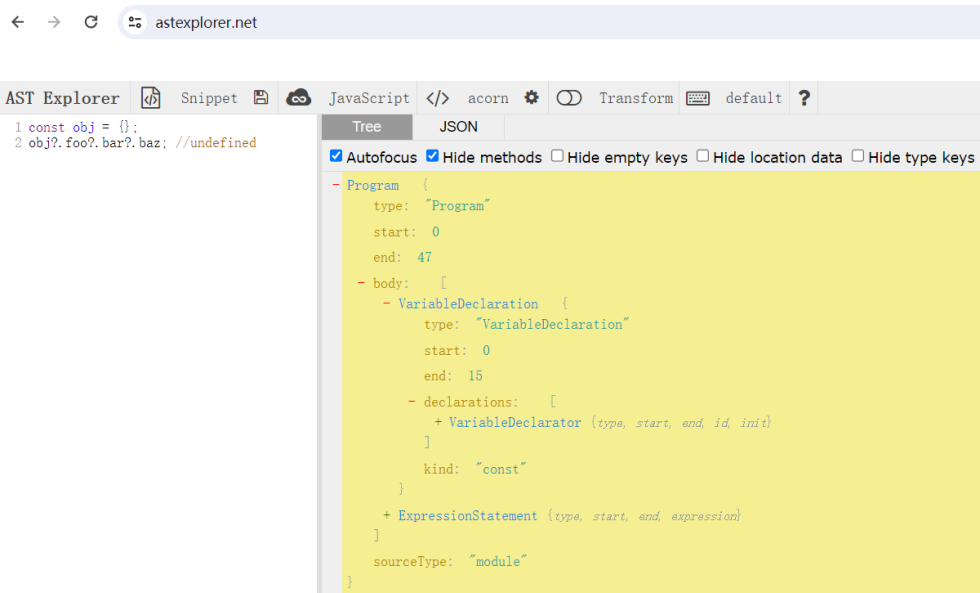
这里我们先安装一个名字叫transform-optional-chaining的babel插件。
PS E:\jsdemo> npm i -D @babel/plugin-transform-optional-chaining
在项目根目录下创建babel.config.js文件。
module.exports={
    plugins: ['@babel/plugin-transform-optional-chaining']
}
再次编译。
PS E:\jsdemo> npm run compile
我们发现target.js变成语法兼容性更好的写法。
var _obj$foo;
const obj = {};
obj === null || obj === void 0 || (_obj$foo = obj.foo) === null || _obj$foo === void 0 || (_obj$foo = _obj$foo.bar) === null || _obj$foo === void 0 ? void 0 : _obj$foo.baz; //undefined
实际项目开发时候,我们通常是使用babel的预设,所谓预设就是babel已经把常用的插件按照顺序已经预设好了。babel里面包括很多常用的预设,包括支持typescript,jsx,基础预设等等。最有名的预设就是大名鼎鼎的preset-env。这里我们安装一下。
PS E:\jsdemo> npm i -D @babel/preset-env
修改babel.config.js如下:
module.exports = {
    /* plugins: ['@babel/plugin-transform-optional-chaining']*/
    presets: [
        ['@babel/preset-env', {
            targets: {
                edge: '17',
                chrome: '67',
                firefox: '60',
                safari: '11.1'
            },
            useBuiltIns: 'usage',
            corejs: '3.34.0'
        }]
    ]
}
在source.js里添加flatMap函数。
const obj = {};
obj?.foo?.bar?.baz; //undefined

const arr = [1, 2].flatMap((x) => [x, x * 2]);
console.log(arr);
重新编译。
PS E:\jsdemo> npm run compile
我们发现target.js里已经自动导入了core-js的es.array.flat-map.js实现了API兼容性转换。
"use strict";

require("core-js/modules/es.array.flat-map.js");
require("core-js/modules/es.array.unscopables.flat-map.js");
var _obj$foo;
const obj = {};
obj === null || obj === void 0 || (_obj$foo = obj.foo) === null || _obj$foo === void 0 || (_obj$foo = _obj$foo.bar) === null || _obj$foo === void 0 || _obj$foo.baz; //undefined

const arr = [1, 2].flatMap(x => [x, x * 2]);
console.log(arr);